


Most meetings start with an agenda and end with a summary. But what happens to all the information in between? Decisions, ideas, and questions from earlier conversations can easily be forgotten as the next meeting approaches. Preparation often starts almost from scratch, even though much of what is needed has already been discussed.
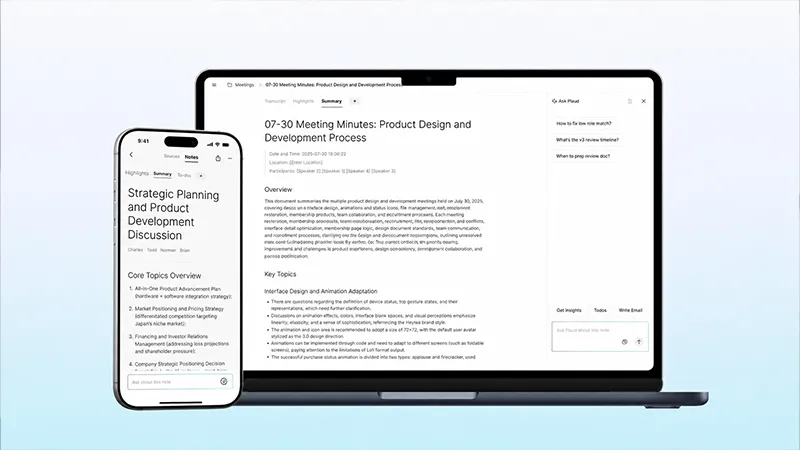
With Plaud, you can use previous recordings and meeting notes as a basis for upcoming conversations. With AI transcription, summaries, and Ask Plaud, you can quickly find past decisions, identify unanswered questions, and prepare a clearer agenda. In this way, meeting notes become not just documentation of what has happened, but a useful tool for what comes next.
Start by looking back at the last meeting
Before the next meeting, it is wise to check what was actually decided last time. Which tasks were assigned? Were there questions that never got an answer? And which topics need follow-up? Searching for the information in long documents or old email threads can take far more time than necessary.
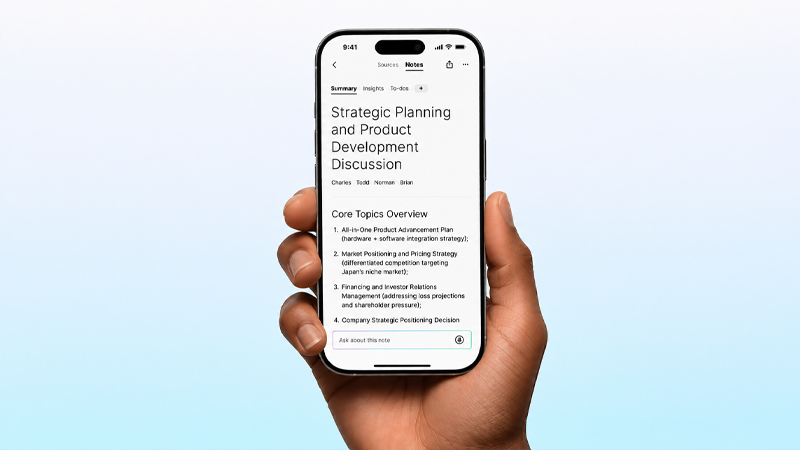
If the previous meeting was recorded with Plaud, both transcription and an AI-generated summary are available to use. With Ask Plaud, you can also ask direct questions about the content. For example, try asking which decisions were made or which questions were left open. That gives you a more concrete basis to work from.
Find connections across multiple meetings
Some questions cannot be resolved in a single meeting. A project may be discussed on several occasions and with different participants. After a few weeks, it can be hard to remember when a particular decision was made or why an earlier plan changed.
Ask Plaud can search information across multiple transcribed recordings. That means you can ask questions that span several meetings instead of opening each summary separately. For example, you can request an overview of how a project has developed or which questions have come up repeatedly in earlier discussions. It makes it easier to see the bigger picture before the next conversation.
Create an agenda based on what has already been said
A good meeting agenda does not have to start with a blank document. Earlier discussions can give you a clear picture of which topics still need to be covered and which decisions are still missing. That reduces the risk of participants spending time on issues that have already been dealt with.
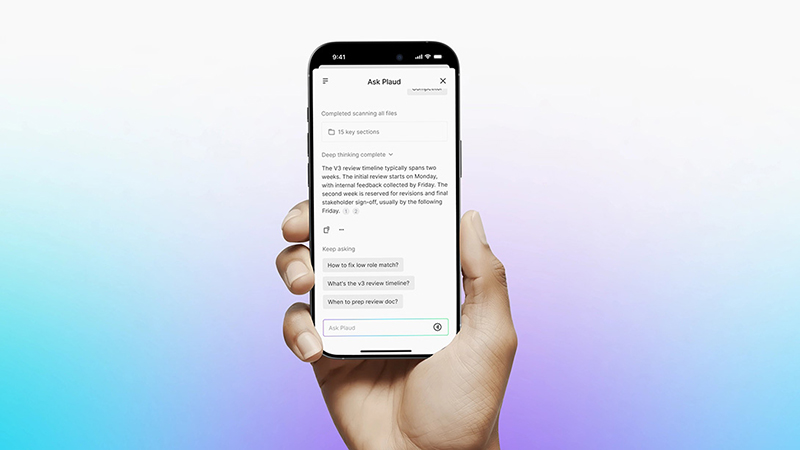
With the help of Ask Plaud, you can identify key points from previous conversations and use them to shape a new agenda. One practical example is asking AI to compile open questions and suggest which topics should be followed up. Then review the suggestion and adapt it to the meeting’s purpose and participants. In this way, AI becomes a support in the preparation process without taking over the planning.
Prepare better questions for the next conversation
It is not always the big decisions that are hardest to remember. Sometimes it is a detail mentioned in passing, a timeline that needed checking, or a question someone promised to come back to.
This is where previous recordings can become especially valuable. By asking Ask Plaud what still needs clarification, you can find details that would otherwise be easy to miss. Before a customer meeting, that might involve earlier wishes, while an internal project meeting may require follow-up on deliverables and responsibility allocation. Always check important details against the original recording before using them as a basis for decisions.
Make every meeting part of a bigger picture
The real value of meeting notes often shows only when they are used again. A summary can be useful right after the conversation, but it becomes even more useful when it helps prepare the next step. Then the same questions do not have to be discussed over and over, and participants can focus on what actually needs to be solved.

With Plaud Note, Note Pro, and the portable NotePin models, you can record conversations that are then transcribed and summarized in Plaud’s platform. Together with Ask Plaud, this creates a workflow that makes earlier discussions easier to return to. Just remember to inform participants about the recording and handle the material in accordance with applicable privacy rules.
FAQ
Can Ask Plaud find information from multiple meetings?
Yes. Ask Plaud can search across multiple transcribed recordings and use the information to answer questions about earlier discussions.
Can Plaud help me create a meeting agenda?
Yes. You can use earlier summaries and Ask Plaud to produce material with questions, decisions, and topics that need follow-up.
Do I need to read the entire transcription before the next meeting?
No. You can start with the summary and use Ask Plaud to find specific details. For important decisions, it is wise to check the original material.
Can I use Plaud for recurring project meetings?
Yes. By recording and transcribing recurring meetings, you can build a foundation that makes it easier to follow the project’s development.
Which Plaud model is best for meetings?
Plaud Note and Note Pro are well suited for meetings at a table and phone calls. NotePin and NotePin S are alternatives for anyone who prefers a smaller device that can be carried throughout the day.